0%
How to Invite and Support a Monk: Vinaya Rules Explained
Nov 10, 2025
Key Points A monk may only ask for his needs if he receives pavāraṇā (invitation). Clear invitations—especially phrases like “any time” or “ever”—create ongoing permission. Invitations are not binding; they simply allow the monk to ask. Renewing the invitation often helps the monk feel comfortable and avoids misunderstandings. Introduction In the Theravāda Vinaya tradition for monks who do not use money, many lay supporters are not familiar with how invitations work1. Several Vinaya rules prevent a monk from asking for his needs unless he is given pavāraṇā (invitation).
read moreIs Shame Good For Meditation?
Jul 16, 2025
Introduction Many people think that hiri (moral shame) and ottappa (fear of wrongdoing) are too heavy for meditation. However, we will discuss not only why they are good qualities but beautiful ones too. These two mental factors are known as the protectors of the world (lokapāla-dhammā).
Why Are They Beautiful? In a previous post and video, I discussed the sobhana cetasikas — the beautiful universal mental factors that arise in all wholesome states. There are 19 of them, and among them are hiri and ottappa (Moral Shame, and Moral Dread).
read moreThe Beautiful Mind in Meditation?
Jul 6, 2025
What does it technically mean to have a “beautiful mind” in meditation—beyond vague metaphores or mysticism.
Defining the Beautiful Mind When modern teachers describe deep samatha (concentration) meditation as “beautiful,” they speak in mystical metaphors. However, real Theravāda Buddhism involves the Abhidhamma. The Abhidhamma is not for scholarly proliferation. It is for knowing how the mind works and applying the mind in that way. The Abhidhamma provides a precise definition: sobhāna cetasikā, or beautiful mental factors.
read moreDoes Buddhism Have A Creator
Feb 3, 2025
Recently, I made a video explaining the common question I get asked in the West. “Do you believe in a creator?” It is a loaded question usually asked by devoted Christians. They are expecting me to say no, but I tell them “Yes”. The real answer is that kamma is the creator.
I quote from the stock phrase below:
“Kammassakomhi, kammadāyādo, kammayoni,
“It is actions that I own, it is actions that I am heir to, it is actions that I am born from,
read moreWhy Do Monasteries Have Skeletons?
Jun 11, 2021
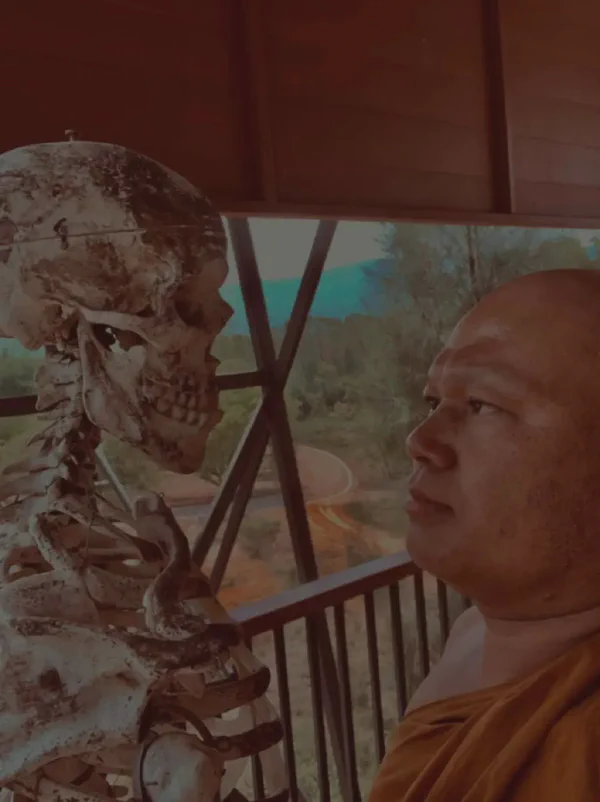
If you go to a Theravada Buddhist forest monastery in Asia, you are likely to find a full skeleton or parts of a skeleton somewhere where it can be viewed easily. Some monasteries also have cemeteries inside the boundary like Pa-Auk Forest Monastery in Mawlamyine. Some other monasteries have a place were dead bodies are burned (with open wood fires), right on the premises, like Pa-Auk Mawlamyine and also Wat Pa Nanachat in Thailand. Wat Pa Nanachat has an enclosed glass case with a skeleton inside located in their main eating hall. Does that sound appetizing? Pa-Auk has a glass case near the entrance of the lower monastery, not far from the cemetery.
read more18th Anniversary and Update
Feb 8, 2019
This is where I live
Wow! Today is February 7th and another year has passed. I have now completed 18 years total as a monk and I am working on my 19th year. Of course, my monk age is 12 rainy seasons because I changed Nikayas after my 6th year. I have been living my monk life in Kauai, Hawaii for about 10 months now and things have been moving along. How long will I stay in Kauai, Hawaii? I’m not sure.
read moreThe Secret Teachings of Theravāda
Aug 3, 2018
If there was a book that had all of the Secret Teachings of Theravāda, The Path of Purification (The Visuddhimagga) would be that book. It explains all the good stuff, like how to attain samādhi concentration; how to attain psychic powers including knowing and seeing the past lives. Lastly, it includes the stages of insight and wisdom that one needs to reach Nibbāna. Books do not get more complete than this. You can read a free and condensed version called Knowing and Seeing by The Most Venerable Pa-Auk Sayadawgyi who teaches this exact method based on The Path of Purification.
read moreVegetarianism and Theravada Buddhism
Jan 12, 2018
Vegetarianism and Theravāda Buddhism I have been asked to write a little something on vegetarianism and Theravāda Buddhism. I am qualified to be quite objective, and to see both sides of the issue because I was a vegetarian for a total of ten years as a lay person and I had vegetarian eyes. That meant that when I looked at meat, cooked or not, I saw a dead animal in front of me. Now that I am a monk, I am no longer a vegetarian although I have lived at vegetarian monasteries for many years, so I know both sides of the coin.
read moreInspire Means To Leave Facebook
Jan 2, 2018
Inspire Means To Leave Facebook Much of what I write about is related to stories that happen to me that would charge me up and make me feel inspired. I would then write down what happened and share it with others. Often my stories are related to vinaya – the monks’ rules and living without money. These days it is special for a monk to live without money and I can inspire people simply by following the rules. However, it really should not be that way. I’m not really that special nor inspiring, but the times have changed, and simply being one who does not touch money seems to inspire people because it is rare.
read moreAre You A Buddhist
Nov 30, 2017
Are You A Buddhist?
Introduction
Being a Buddhist is quite open because if you believe in certain aspects it is better than not believing in anything. We take what we can get. However, here are the more traditional aspects of being Buddhist. One should believe in The Triple Gem – ie**: The Buddha, The Dhamma and The Sangha).** This can be expanded to include The 4 Noble Truths. This can be expanded to include the Eightfold Noble Path as well. The Four Noble Truths also include a belief in cause and effect and past lives (aka **Saṁsāra).** Lastly, one should live by these ideals and follow the five precepts for morality, and follow the Eightfold Noble Path which includes meditation for the purpose of gaining Buddhist wisdom with the goal of reaching Nibbāna. If one is a Bodhisatta (Skrt. Bodhisatva), and wishes to attain full Self-Enlightened-Buddhahood, one should still have an ultimate goal of Nibbāna but delaying it to attain the full perfections. However, a Bodhisatta should strive to attain mundane insight knowledges while they are available in this lifetime.
read moreThe Dark Side of Ajahn Mun's Biography
Oct 21, 2017
Ajahn Mun dark
Did Ajahn Mun say the Buddha congratulated him on the night he attained arahant? His biography books says it for sure.
Venerable Ācariya Mun Būridatta Thera is one of the most revered forest masters of the 20th century. He is the root guru of both the Dhammayut and Ajahn Chah monasteries. He popularized the monastic practice of living under an umbrella in the forest and his relentless energy is fascinating and inspiring. Although I quote controversial words from the book written about him, I still find his “way of life” inspiring. It is also not proven 100% that these are really the words of Ajahn Mun. On the other hand, I don’t believe his biographer would lie or is lying.
read moreDoes The Buddha live in Nibbana
Sep 10, 2017
The Buddha in the clouds
Does the Buddha Live in Nibbāna? Many people believe that the Buddha is alive and living in some sort of transcendental realm called Nibbāna where he can hear your prayers and eat and drink the food and water that you offer to Him. We Buddhist monks smile when we hear that people have such beliefs because nobody lives in Nibbāna, not even a Buddha.
This is wrong view, and any teacher or monk who believes and teaches this is surely not enlightened because permanently removing wrong view is part of enlightenment (in Theravāda). “So where is The Buddha then?” you might ask. The Buddha as far as a “being” is concerned dead and gone. There is only (dead) material form from his bodily remains that exist today. When The Buddha died, He did not take another birth. He achieved the final goal of Buddhism, which is to not be reborn ever again. His Arahant disiples have also achieved that goal too. There is no difference between a Buddha and an Arahant disciple after death. Any trace of them, is nowhere to be found. However, their physical remains may have been saved to represent the power of those who have achieved the final goal. There is no remainder other than that dead and lifeless material.
read more