How to Invite and Support a Monk: Vinaya Rules Explained
Key Points
- A monk may only ask for his needs if he receives pavāraṇā (invitation).
- Clear invitations—especially phrases like “any time” or “ever”—create ongoing permission.
- Invitations are not binding; they simply allow the monk to ask.
- Renewing the invitation often helps the monk feel comfortable and avoids misunderstandings.
Introduction
In the Theravāda Vinaya tradition for monks who do not use money, many lay supporters are not familiar with how invitations work1. Several Vinaya rules prevent a monk from asking for his needs unless he is given pavāraṇā (invitation).
aññatra punapavāraṇāya, aññatra niccapavāraṇāya
except for repeating invitations or non-expiring invitations.
A Jātaka Teaching
The Brahmadatta-Jātaka (Jātaka 323) tells of an ascetic (our Bodhisatta) who lived in the king’s garden for twelve years, longing only for a pair of single-soled sandals (slippers) and a parasol of leaves so he could return to the Himalaya Mountains. He never asked because he feared damaging their relationship. The king eventually realized this and asked what he needed. Only then did the ascetic request slippers and a parasol to return to the Himalayas.
This shows that even when support exists, a monk may refrain from asking if the relationship is uncertain.
Types of Donor Invitation (pavāraṇā)
Full Donor Invitation: A supporter (individual or committee) gives a clear invitation permitting the monk to ask for his needs “at any time, anywhere, anything.”
Family Member: A family member by a genetic line up to seven generations is automatically a full donor. No invitation is needed. “Family,” by means of marriage or adoption does not qualify.
Item Donor: The supporter provides only certain items but not others. For instance, he might invite only for meals (piṇḍapāta), and robes (cīvara), but not other items. The monk cannot ask for other needs outside that limited list. For example, the monk may not request books or pens with this offer.
Allowable Requisites Donor: The donor offers allowable requisites through a steward. A form or receipt confirms the value and invitation limit. The steward uses discretion to acquire what is needed and gives allowable items to the monk.
Note: If a donor receives a tax deduction, the donation is legally restricted for charitable purposes directed to that organization (the monk cannot use it personally).
Limited Donor: A donor (or steward) states how much he will sponsor and may set duration or automatic renewal.
One-Time Donor: “I’m visiting soon. Is there anything you need?” The invitation is for that moment only.
Beyond Means Donor: Often for committees or community leaders: A supporter gives full invitation and also says the monk may ask beyond his personal means. This assumes the donor will organize others to help if needed. Story below:
Paṇḍita-sāmaṇera-vatthu dhpA80
“Venerable Sir, tomorrow receive alms from me.” – “How many bhikkhus do you wish me to bring?” – “How many bhikkhus are there in your retinue, venerable Sir?” – “Twenty thousand bhikkhus.” – “Venerable Sir, tomorrow bring all your bhikkhus and receive alms from me.” The Teacher accepted his invitation.
The man entered the village and announced: “Men and women, I have invited the Saṅgha of bhikkhus presided over by the Buddha to take a meal here tomorrow; each and all of you give to as many bhikkhus as you are able.”
 Render of husband and wife inviting a monk.
 Donations received during Pa-Auk Kathina
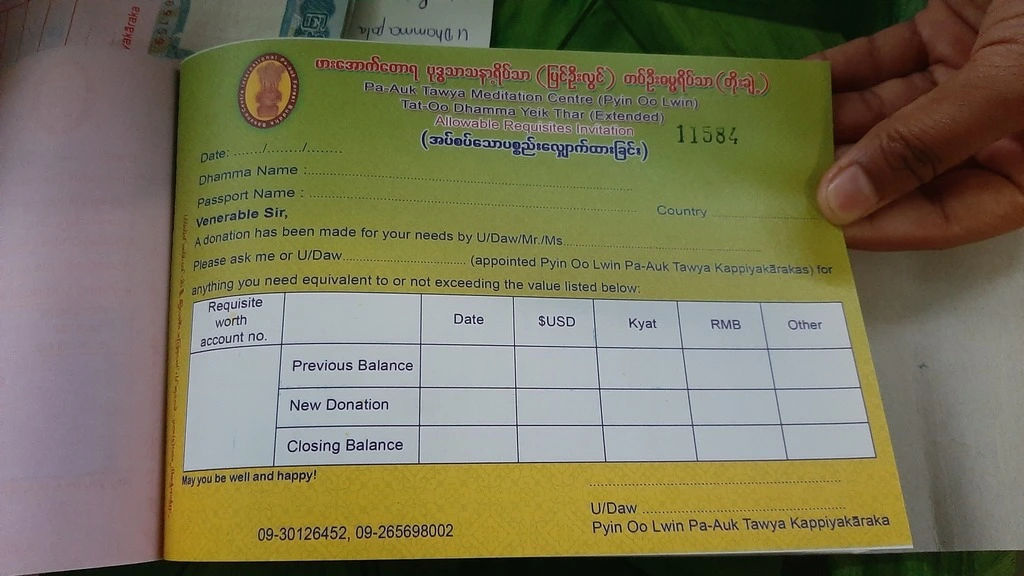 Sample Requisites Donation Form from Pa-Auk
Duration and Renewal
Avoid ambiguities and state how long the invitation is good for, or be clear it is ongoing. A Nicca-pavāraṇā (non-expiring invitation) is created with expressions like “any time,” or “if you ever need anything.”
The monk should not ask for items beyond the donor’s means or faith. He must judge carefully and ask appropriately based on relationship and circumstance.
Invitation Is Not Binding
Invitation does not obligate the donor to give. It only grants permission for the monk to ask. After that, the donor or steward may use their judgment.
Renew Often (like saving a file)
A donor should renew his invitation often. Experienced supporters reaffirm every time they see the monk. Why? A monk may misread silence, tone, or a facial expression and think the relationship is broken. Then he will stop asking, even if nothing is wrong.
Renewal keeps the invitation alive and the monk feels comfortable again.
Invitation Wording Examples
Committee Invitation
“According to our meeting, if you need anything at any time, anywhere, even beyond our means, please let any of our committee members know. If the request is over $____ according to our bylaws, we will have a meeting about it.”
Personal or Family Full Invitation
“If you ever need anything, please let me (or us) know.”
or
“If you at any time need anything, please let me (or us) know.”
Personal Time-Limited Invitation
“If you need anything for one month, please let me know.”
Specific Item Invitation
“If you ever need robes, please let me know.”
Specific Item With Time Limit
“If you need robes during this July, please let me know.”
Requisite Form
“Bhante ﹏﹏﹏﹏﹏,
I ﹏﹏﹏﹏ have given Allowable Requisites having the value
of $﹏﹏﹏﹏ to your steward named ﹏﹏﹏﹏.
If you need anything at any time, up to the value of those requisites, please let that steward know.”
Conclusion
When lay supporters understand how invitations work in the Vinaya, and when monks feel safe to ask, the Dhamma flourishes without burden or confusion. It should be seen as an “invitation to ask,” but it is non-binding.
Good support is a clear relationship, goodwill, and done with a proper invitation.
Summary of Jātaka 323
In silence the hermit endured through years,
Needing so little, yet bound by fears.
Not wanting friendship to break or bend,
He waited twelve rains with hope to end.The king one day with kindness spoke,
“Tell me your wish,” the stillness broke.
“Sandals and shade for the road I tread.”
The king rejoiced — compassion spread.
You may distribute, translate, or create a booklet if you wish, provided you include a proper link to the original.
This article was written after someone asked, “What does this mean?” in reference to the word invitation. It was composed as a general teaching for the benefit of all laypeople who wish to understand. ↩︎
Join Our Mail List

Click below to search subjects