Why the Different Colors?
Why is it that some monks have robes made out of many different colors, while most monks seem to have a single robe color?
Actually, all monks must wear robes that are stitched together from small pieces of cloth. Because they are usually dyed the same color, you might not notice the seams, but they are there. The Buddha once looked at a rice paddy field and really liked the pattern. Ever since then, that became the standard robe pattern for the monks.
The Rice Paddy Pattern
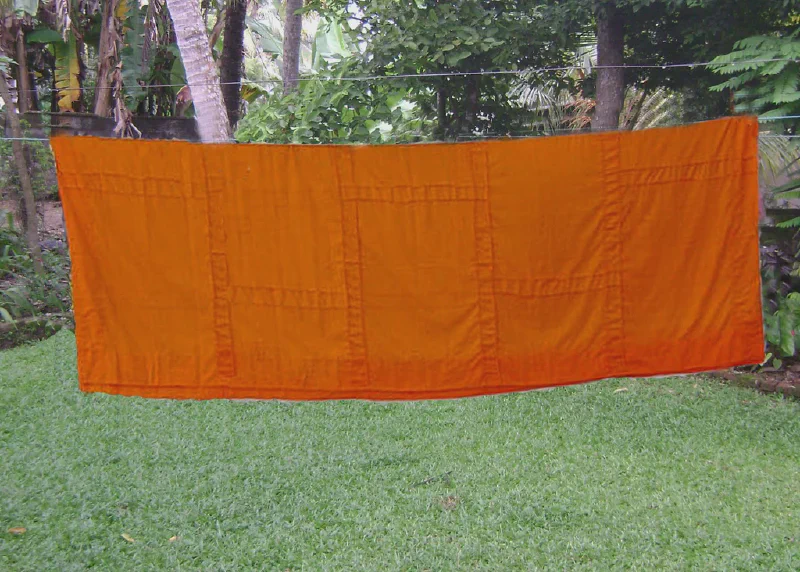
If you look closely at a monk’s robe, you’ll notice it is made of rectangular panels sewn together, separated by thin strips. This pattern is meant to resemble the neat rows of a rice paddy field when viewed from above. It’s actually quite beautiful when you understand the origin. The Pāḷi term for this pattern is khandha, and the thin border strips are called kusis. The number of panels (or khandhas) varies depending on the size of the robe, but they must always be an odd number — five, seven, nine, or more.
So Why Do Some Monks Have Multiple Colors?
As a robe gets old, a monk might patch the worn-out cloth with whatever scraps of fabric he can find. After several years, the robe becomes entirely made out of patched pieces of cloth. I once did this with my lower robe for four years, but ultimately gave it up because it was just too much work to constantly repair.

Every time a section would wear thin or develop a hole, I’d find a piece of scrap cloth and sew it over the damaged area. Over time, the robe becomes like a quilt — each patch a slightly different shade of brown or maroon or ochre. Some monks really embrace this look and take pride in it.
Paṃsukūla — The Rag Robe Practice
Monks are allowed to choose to make robes either entirely from discarded cloths or from new cloths. In most monasteries, we have many extra robes that are slightly used from temporary ordinations, or they are just undesired and eventually abandoned.
We don’t normally throw away these robes. Instead, they are kept in the sewing room or in the storage room. A monk can take these discarded robes and sew a robe together in order to follow a dhutaṅga ascetic practice of wearing paṃsukūla (discarded/rag) robes.
The word paṃsukūla literally means “taken from a dust heap.” In the Buddha’s time, monks would collect cloth that had been thrown away — sometimes even from cremation grounds — and wash, dye, and sew them into robes. Today, the practice is a bit more refined, but the principle is the same: using cloth that nobody else wants.
It’s Not Easy
If you think this sounds simple, it’s not. Repairing robes is often done by needle and thread, and the stitching needs to be strong enough to hold up during daily use, washing, and the wear that comes from walking, sitting, and sweating in tropical climates. When I was patching my lower robe for those four years, it was a constant project. I’d fix one section and another would start to go not much later on. Eventually, I decided my time was better spent meditating than sewing!
A Beautiful Practice
Despite the extra effort, there is something really admirable about a monk who wears paṃsukūla robes. It shows contentment with little and a willingness to put in the work rather than simply accepting new, comfortable cloth. When you see a monk with an old robe that has many different shades and patches, know that a lot of work goes into the upkeep of the robe.
And that is why some robes have multiple colors!
Summary Poem
A rice field pattern, neat into rows,
The Buddha saw, and the Buddha knows.
Each robe is stitched from panels small,
A uniform color blends them all.
But as the years wear cloth away,
A patch is sewn to save the day.
Brown and ochre, tan, and maroon,
Colors from patches, not from the loom.
Paṃsukūla, the rag robe way,
From discards, robes are made today.
A monk who wears what none desire,
Shows contentment monks admire.
YouTube Video
Click below to search subjects
Join Our Mail List
Get updates on new Dhamma teachings, essays, and videos delivered to your inbox.
Subscribe to Updates