Did You Know?
Did you know that the rainy season, which is also called vassa, actually starts the day after the full moon, rather than on the full moon day itself?
Not many people know this, but why is that?
It’s because the full moon day is actually the last day of the lunar month. The new lunar month begins on the day just after the full moon. Although the public ceremonies for the lay people are held on the full moon day, that’s just for the laity, which is why most people don’t realize how the monastic calendar works.
See It For Yourself
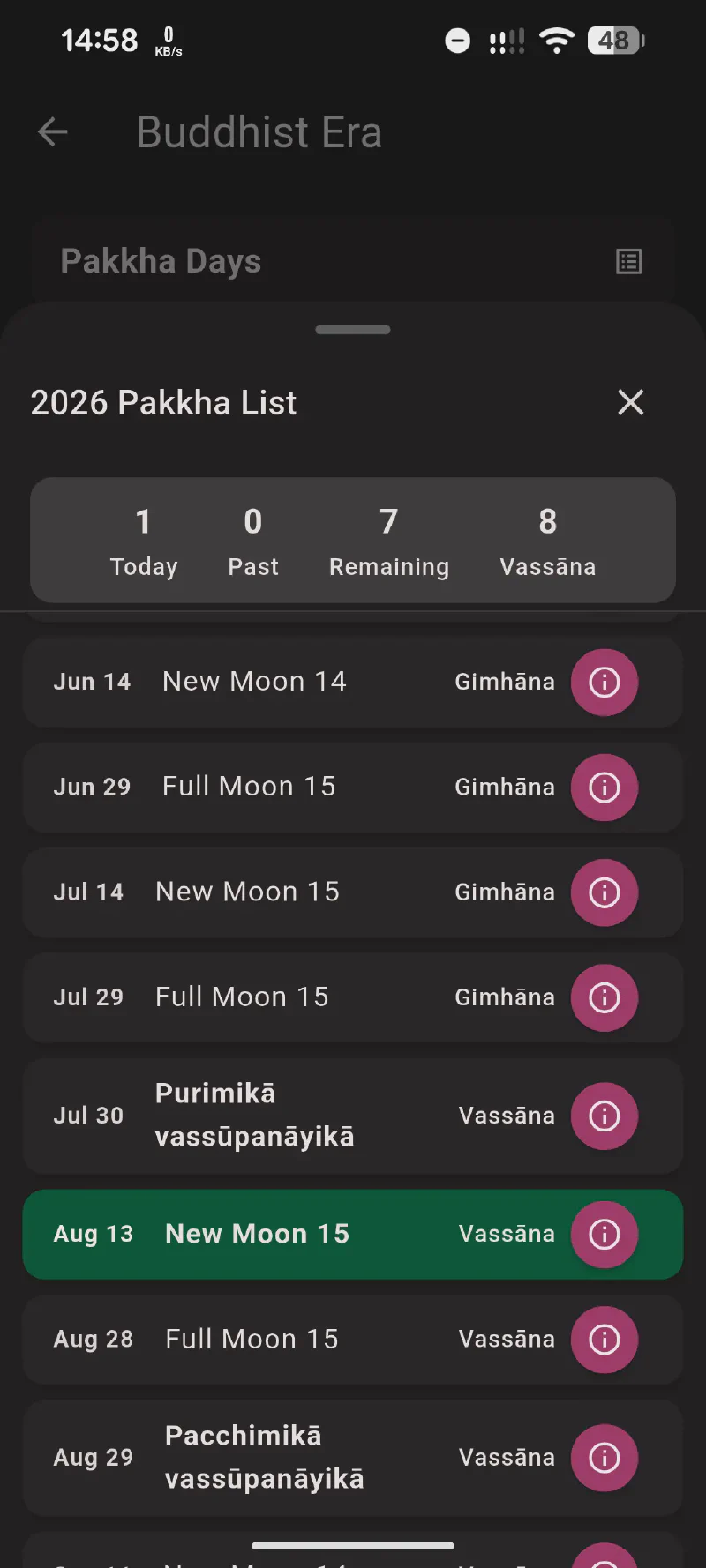
You can actually see this clearly right on the Buddhist Sun App. On the menu of Buddhist Era, there is a pakkha button. If you press that, you will see the special days—the full moon day and the start of vassa. You can also see that today is the first day of Sāvana month.
Why Does This Confuse People?
Most calendars you find online, and even many monastery calendars, will list the full moon day as the start of vassa. This is because the full moon day is the big public event — the day when the laity come to offer robes, food, and other requisites. There are chanting ceremonies and the monks give dhamma talks. So naturally, people associate that day with the beginning of vassa.
But from a monastic perspective, the full moon day is actually an Uposatha day — the last day of the outgoing lunar fortnight. The Pātimokkha (the monastic code of 227 rules) is recited on this day as it marks the completion of the cycle. Think of it like December 31st — it’s the last day of the old year, not the first day of the new one.
How the Lunar Calendar Works
In the Buddhist lunar calendar, time is counted in pakkha — fortnights that run from new moon to full moon and from full moon to new moon. Each fortnight is either 14 or 15 days long. The Uposatha day (full moon or new moon) is the final day of the pakkha, and the new pakkha begins the following dawn.
So when we say vassa starts on the “first day of the waning moon of the eighth lunar month,” that is the day after the full moon Uposatha. The monks have already done their ceremony, recited the Pātimokkha, and formally resolved to enter the rains retreat. The next morning, vassa has officially begun.
You can see that for year 2026, the Full Moon day is July 29th, while the First Day of Vassa (Rainy Season), starts the day after on July 30th.
A Common Mistake
Over the years I see people saying, “Happy Vassa!” — on the full moon day itself. It’s a harmless and common mistake, but technically they are one day early. At Pa-Auk and other vinaya monasteries, we are careful about this because our teachers follow the commentarial tradition closely.
If you really want to understand how the monastic calendar works, I recommend reading my post on why vassa is late sometimes and my earlier post on when the rainy season starts. Together with this post, you’ll have a pretty complete picture of how the Buddhist calendar works.
Check the Buddhist Sun App

If you want to verify all of this yourself, download the Buddhist Sun App . It’s free, available on both iOS and Android, and it shows you the Uposatha days, the pakkha cycles, and even which Buddhist month we are currently in. It’s a handy tool for monks and laypeople alike.
Summary Poem
The full moon shines, and the people pray,
Think that vassa starts that very same day.
But the monks who know the old ancient way,
Begin on the vassa on the following day.The moon marks the endings, and not the start,
The fifteenth day completes only a part.
A new pakkha dawns with morning light,
The rains retreat begins after a night.So check the app, and see it is clear,
That the Sāvana month is finally here.
The ancient calendar holds the old way,
Of the Vinaya Saṅgha, as they count the days.
Click below to search subjects
Join Our Mail List
Get updates on new Dhamma teachings, essays, and videos delivered to your inbox.
Subscribe to Updates