The Secret Mechanics of Not-Self: How to Actually Practice the Anattalakkhaṇa Sutta
Introduction
The Anattalakkhaṇa Sutta is rarely talked about in terms of suttas meant for practice. Instead, we normally only hear about two suttas for meditation: the Satipaṭṭhāna Sutta (The Foundations of Mindfulness) and the Ānāpānasati Sutta (Mindfulness of Breathing).
The Anattalakkhaṇa Sutta is the Buddha’s second discourse. During the first discourse, only one of the five original disciples attained Stream-entry. Through practice, the other four disciples gained Stream-entry too. It was only after hearing this second discourse on Not-Self (anattā) that all five became Arahants, fully enlightened disciples.
Although it is one of the most powerful teachings in the entire Pāḷi Canon, it is commonly ignored as a meditation manual and often read in a compressed format. If you look at English translations, the most important part of the sutta is often abbreviated out with dot-dot-dots (peyyāla), which literally means “repetition.” This leaves readers to assume they understand what comes next, but all is lost if one skims over it, which most readers do. For reading, yes, you might want to skip over and just note a repetition. However, if there is a repetition, it often means there are instructions to be repeated through practice.
The Five Aggregates
The Anattalakkhaṇa Sutta is concerned with the Five Khandhas or Aggregates:
- Form (Rūpa)
- Feeling (Vedanā)
- Perception (Saññā)
- Mental Formations (Saṅkhārā)
- Consciousness (Viññāṇa)
The Six Sense Doors
Even though it is not explicitly detailed in the sutta, we cannot have the Five Khandhas without the six sense doors through which they arise:
- Eye
- Ear
- Nose
- Tongue
- Body
- Mind
Because the mind moves so incredibly fast, we mistakenly believe we see, hear, think, and feel all at the same time. Think of a ceiling fan running at top speed. It appears to be a single, solid, unbroken disk. But turn it off, and you see separate blades with empty space between them. The cognitive process is identical. Eye-door consciousness and ear-door consciousness never happen simultaneously. In fact, between moments of seeing and hearing, the mind continually lapses into the life-continuum (bhavaṅga).
The 11 Ways And The Matrix
To remove this illusion, the Buddha provides a practical meditation matrix in the third section of the sutta: The 11 Ways.
The Buddha instructs us to evaluate the five aggregates across eleven dimensions (Ekādasavidha):
- Past (Atīta)
- Future (Anāgata)
- Present (Paccuppanna)
- Internal (Ajjhatta)
- External (Bahiddhā)
- Gross (Oḷārika)
- Subtle (Sukhuma)
- Inferior (Hīna)
- Superior (Paṇīta)
- Far (Dūre)
- Near (Santike)
That means that we must read the 11 ways as above for each and every one of the five khandhas. But it gets more complex than that. Why? Well… for starters and just a small portion, we can do past internally, but also do past externally for each of the 5 khandhas. That’s an extra round right there! Then we must do present internally, present externally… and again with future internally and future externally. This is only 3 categories, but if you add on the other 8 categories, you will find that you have a lot of meditating to do.
In total, you will have to combine them with all combinations. Not only that, the five khandhas refer to an object, and the object happens through the six sense doors, so we can repeat all of that six times. Furthermore, there are many different types of consciousness. If we merely limit it to wholesome and unwholesome, that whole matrix will repeat two more times.
The matrix gets big quite fast, and we have yet to use the Abhidhamma to explain what the 11 ways mean. Like, what counts as subtle, or superior, or near? Luckily, subtle and superior are often the same for the mental aggregates while gross and inferior are also often the same for the mental aggregates too.
To actually practice this, we have to look outside the Suttas and open the second book of the Abhidhamma: the Vibhaṅga.
The Vibhaṅga’s Hidden Matrix
In the English-speaking world, teachers usually recite this 11-fold list as if the words are just common sense. We know what “near” and “far” mean physically. For material form (rūpa), things that are easy to discern are near, and things difficult to apprehend are far.
But what is a “far” perception? What is a “near” feeling? Physical distance makes no sense for the mind.
The Vibhaṅga defines these terms with absolute precision. For mental states, “far” means opposing states. Unwholesome consciousness (akusala) is “far” from wholesome consciousness (kusala) because they cannot happen at the same time. “Near” would mean they are of the same category: Wholesome is near to wholesome. Unwholesome is near to unwholesome, etc. So when we recognize what is best for us, and what is not good for us, we will naturally know that we want to keep the good near to us and the bad far from us. That means we should sustain wholesome consciousness and avoid unwholesome consciousness. But that is only the start. What is good?
When the sutta asks you to look at what is “inferior” and “superior,” or “gross” and “subtle,” it is showing you exactly what is best for your mind. Unwholesome states rooted in craving and anger are gross and inferior. Wholesome states are subtle and superior. However, the absolute most subtle and superior states are avyākata (indeterminate)—the karmically neutral consciousnesses, such as the pure bare consciousness of the eye-door.
How to Practice Systematically
Nobody teaches this as an active system. But when you apply it, you are rebuilding the bridge between the Suttas and the Abhidhamma.
You do not sit and vaguely note “seeing, seeing” or “thinking, thinking.” You intercept the cognitive process at the six sense doors. Take the eye-door: First, you isolate the physical base (the gross form of eye sensitivity (cakkhupasāda) and the external light). Then, you isolate the mental aggregates. You catch the exact mental state that just occurred—perhaps a moment of craving for a pleasant sight—and you systematically sweep it through the 11 ways.
The Buddha started this sutta by showing that we have no ultimate control over the aggregates (“Let my form be thus; let my form not be thus”). Because we cannot control them, they are suffering. So as you sweep, you should note that the aggregate is impermanent. You should know that what is not permanent is suffering. You should know that what is impermanent, suffering, and bound for change cannot be controlled, and therefore it is not self.
The Contemplation For Disenchantment
When you systematically reflect on the wholesome or unwholesome, you might note:
“This sight seen in the eye-door is indeterminate; it has no craving in the bare eye-door consciousness. However, just after that, this object of color is craved in the mind door located in the heart (hadayavatthu). This craving is gross, not subtle. It is inferior, not superior. It is far from wholesome consciousness. This is not good for me.”
Then you contrast it against its subtle, superior, far counterparts. When you constantly compare what is inferior to what is superior, the mind naturally develops a preference for peace.
Think about using a brand-new, lightning-fast computer versus a 10-year-old computer that struggles. You have used the old computer for ten years. It struggled, but it did its job for ten years. But then you get a brand new computer. It is much better, and you might forget about the old computer. Then one day, you need to find an old file on your older computer. You use it, it takes time to boot up, and you can easily see the difference.
You want to do the same with the mind. Understand that what is subtle and superior should be kept near to you (sustained). In contrast, what is gross and inferior, you will want to keep far away from you (abandon quickly). You will naturally see that “This is not mine, I am not this, and this is not myself.”
By running through this complex matrix systematically one by one, khandha by khandha, sense door by sense door, wholesome, unwholesome, and indeterminate, you get a taste of the subtle and the superior. When you fall back into craving or anger (the gross, the inferior), the mind is naturally disgusted by it. This disenchantment (nibbidā) is the engine of the Anattalakkhaṇa Sutta. You don’t just intellectually repeat “this is not mine.” You relentlessly expose the mechanical, uncontrollable friction of the aggregates, constantly shifting the baseline until the mind has absolutely nothing left to cling to.
Safe and Practical Application
This practice can be done in a systematic way by taking one of the six sense doors and then seeing it in the 11 ways for each of the five khandhas. Then repeat with the next sense door. You can also take the eye door and see that same object arise in the mind door. In this way, one only needs to do this five times yet still covers the six sense doors.
If possible, one should try to see at least one wholesome citta for each door in the past, future, and present. When it comes to unwholesome states, one should at least do greed (lobha) and anger (dosa) for each of the senses, but only do past objects. We should not make ourselves intentionally angry or greedy. See it in the past and know what is good and what is bad. Try to develop a wholesome mind that is subtle and superior, and keep that near to you (sustain it with the same class of consciousness). When you see unwholesome states, try to develop a mind that is wholesome, so you can keep those unwholesome states far from you.
To do this in the proper way, you should really develop the light of wisdom through proper concentration to see the real paramattha dhammas (ultimate realities), and see them as anicca, dukkha, and anatta. However, even without concentration, you can still practice this method on a conceptual level (sammuti) and get immense benefit.
One time, I saw chicken cooking on a grill, and I saw body parts on the grill. I became a vegetarian for a very long time as a layperson due to seeing that reality, yet it was not on the paramattha level. Although it was not permanent and I am not a vegetarian now, I can remember that state of disenchantment if I want to. In the same way, although practicing at the superficial level might not yield permanent liberation right away, you can still practice this way and get tremendous benefit.
May you practice these dhammas one by one and see for yourself that the Anattalakkhaṇa Sutta has profound wisdom—not just for reading, but for actively practicing the matrix of khandhas and sense doors through the 11 ways and the various mind states.
Summary Poem
Five aggregates coupled with the each six sense door,
But that is not enough for the mind to explore.
Through eleven more ways we look and compare,
To witness the faults, and keep the good near.
Compare what is gross to the subtle and pure,
Keep the wholesome near as a peaceful cure.
Disenchantment awakens when suffering is known,
Not me, not myself, and nothing to own.
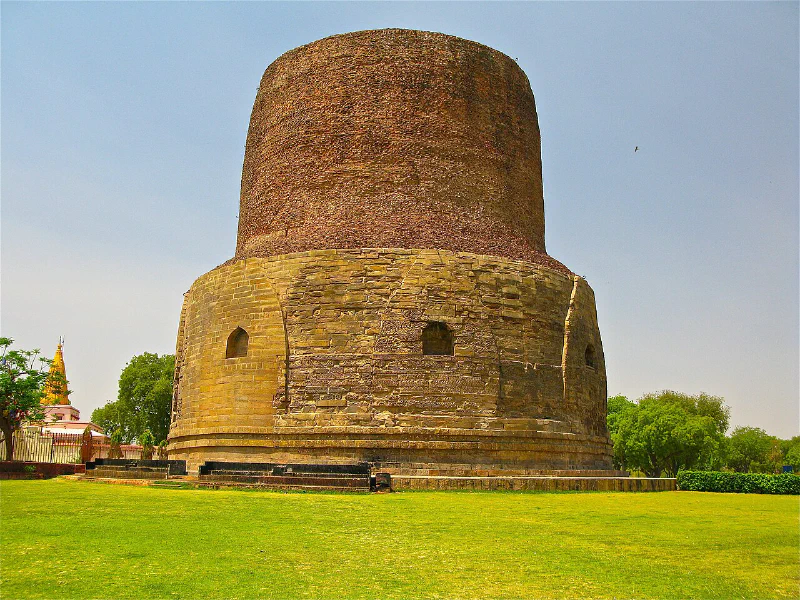
Photo attribution: Dhamekh Stupa, Sarnath by Ken Wieland, licensed under CC BY-SA 2.0.

Click below to search subjects
Join Our Mail List
Get updates on new Dhamma teachings, essays, and videos delivered to your inbox.
Subscribe to Updates