Featured Posts

Where to Ordain?
Jan 1, 2026
Picture of pabbajja novice ordination in Pa Auk (8th April 2014)
Updated January 1, 2026
Summary: If you are looking to ordain at places that have Theravāda Buddhism and follow vinaya (places that don’t touch money), and you believe in the Commentaries and Abhidhamma and want to meditate, you have two choices: Pa-Auk and Na-Uyana. There is a new place in Thailand as well. If you don’t believe in the Commentaries and Abhidhamma, you are best off at a Thai Forest Monastery such as Ajahn Chah (Mahanikaya) or Ajahn Maha Boowa (Dhammayut) monasteries. Both traditions have a presence in the West and in Thailand. There are other places that I might recommend too. I will mention them later.
read more
Why did you become a monk?
Oct 1, 2023
Probably the #1 question we get is, “Why did you become a monk?” That question has many factors and answers. However, a better question is, “How did I actually get the nerve to become a monk?” I had a lot to give up. I was a computer programmer and really enjoyed my job. It did not feel like work actually and I was also making more than 15 times what someone on minimum wage was making at that time. I had gone through the “Should I stay or should I go?” routine many many times but never really committed myself to monkhood.
read more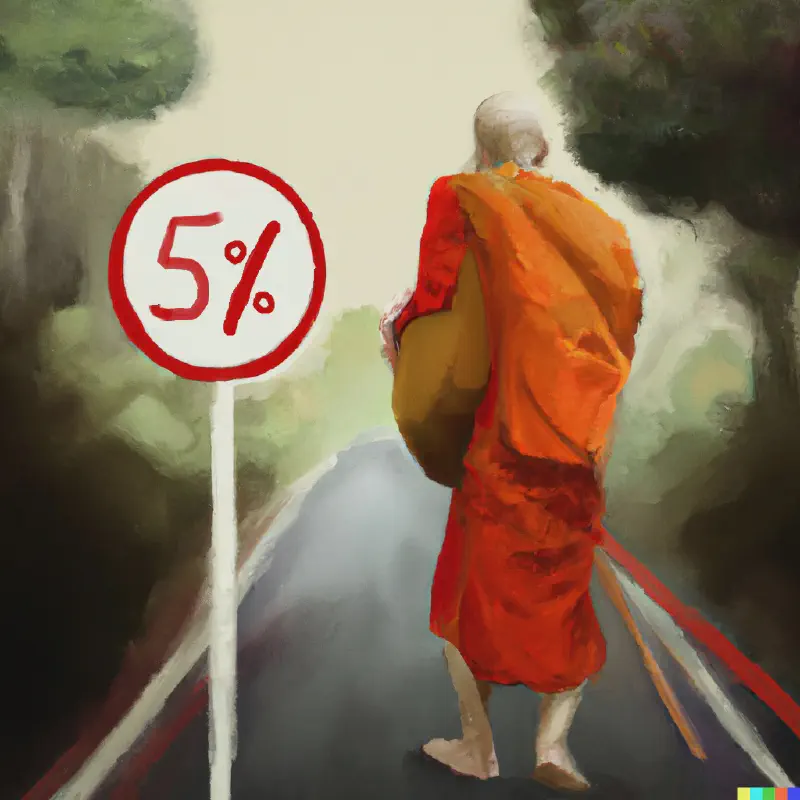
Percentage of Monks Who Do Not Use Money
Mar 23, 2023
Monk walking towards the world of the 5%
If you are a Westerner and new to Buddhism, you might be surprised to learn that most monks use and handle money. I have calculated that around 95% use money while 5% do not use money. The general consensus of those I have consulted say that about 2 or 3 percent do not use money but I used a 5% number to be safe. In this article I will give an itemized number crunch and explain how I came up with those numbers and you can see if 5% is safe and maybe double my original estimate.
read more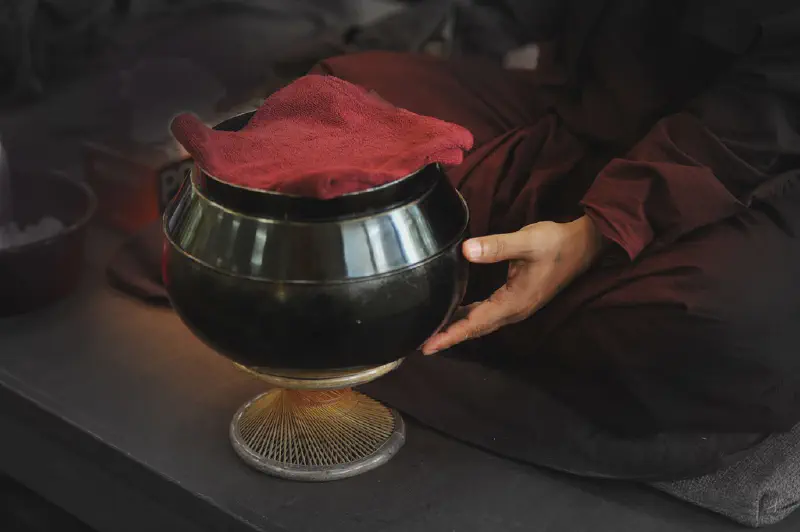
The Buddhist Monk's Bowl
Oct 21, 2022
Bowl with bowl stand (maybe Pa-Auk)
There are certain characteristics of the Theravada Buddhist monk’s bowl that might be interesting to know, even though the information is quite dry. Enjoy!
Material: The Buddha has allowed two different types of materials for bowls: iron and clay. When we say iron in Asia, we mean steel. Stainless steel is called steel. Is stainless steel allowed? This metal was not invented yet, but The Buddha left us with the great standards to judge if something should be allowable that was not mentioned during the time of the Buddha. Because it is strongly resistant to most rust, and still contains iron, it has been unanimously decided that stainless steel is allowed. Today, it is one of the most popular long lasting bowl materials used.
read more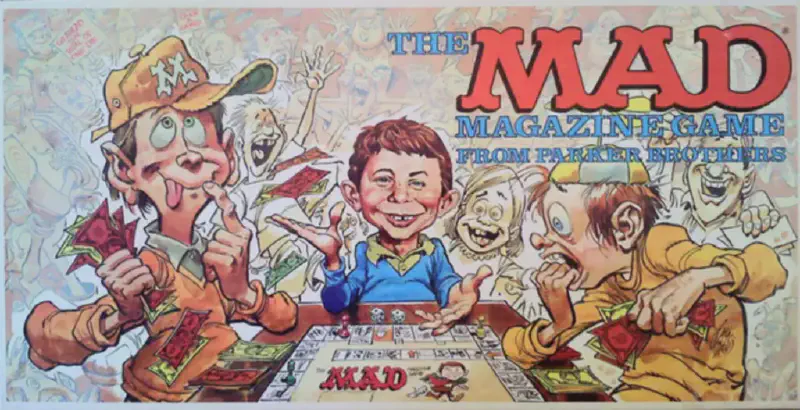
How Do Monks Live Without Money?
Jul 29, 2022
Introduction One of my childhood favorite board games made by MAD Magazine. Unlike other games, the object of the game was to lose all of your money.
In the last post, it was mentioned that the majority of Theravāda monks use money even though it is clearly not allowed, is a form of disrespect and defiance to the Buddha wishes and because of the moment to moment accumulation nature of using money or things bought with money, it adds up just like the drops of rain fill rivers which in turn fill up the oceans. The Buddha had also paired the use of money with three other unallowable actions such as sex, use of intoxicants, and wrong livelihood to show how bad the kamma really is. Because of this, it should be very clear that the use of money by monks will almost surely lead to an unhappy destination.
read more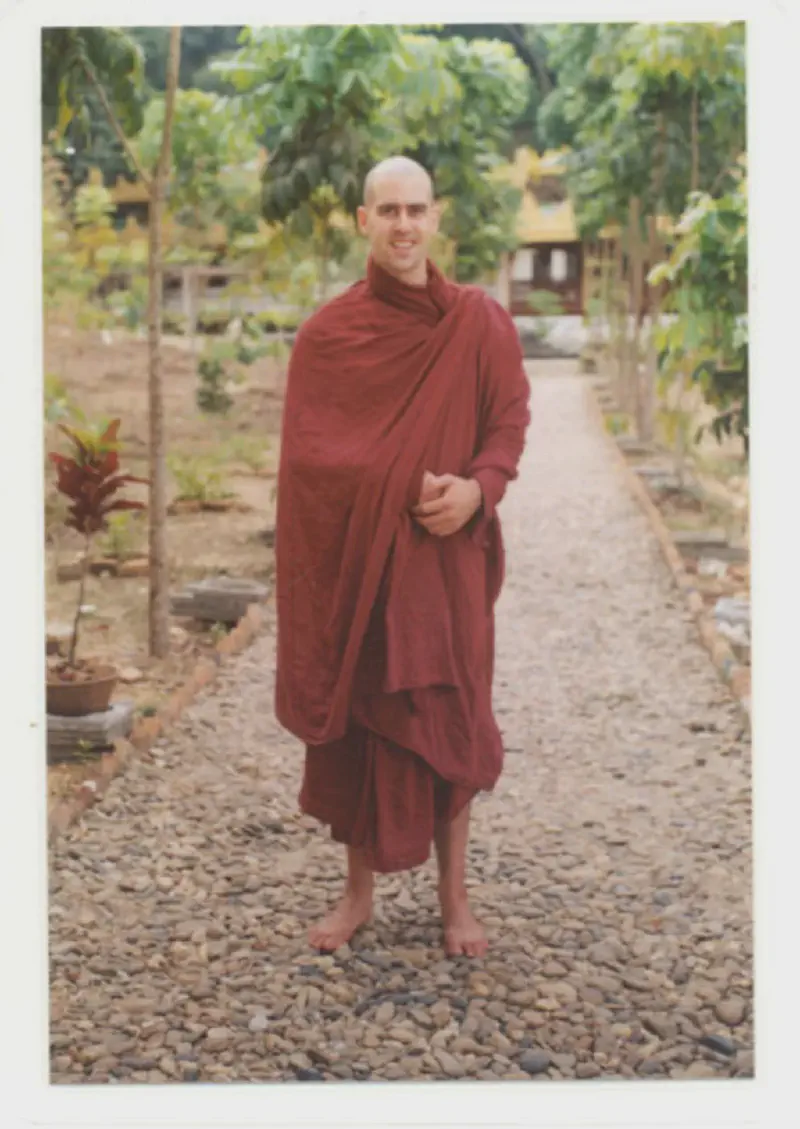
How I Got My Name
Feb 6, 2021
One of my earliest photos with messy robes
My original ordination certificate
Exactly twenty years ago today (February 7, 2001), I followed through with my decision to ordain with lifelong intentions. Although I am only 14 vassa because of a re-ordination ceremony, this day means more to me than my very own birthday. This day was also the day I got my name.
Today, I not only have the monk name Bhikkhu Subhūti, but I also have an actual legal passport name of Bhante Bhikkhu Subhuti as well as other essential ID’s too. I remember when I came to Pa-Auk still dressed in white anagārika robes that I got at Wat Pah Nanachat in Thailand when Myanmar was still an embargo state. There were about 120 monks total at Pa-Auk and just a handful of foreigners. Today, (without a pandemic) that number has grown in Mawlamyine to a rolling average of 600 monks in addition to the monks at 60 or so branch monasteries.
read more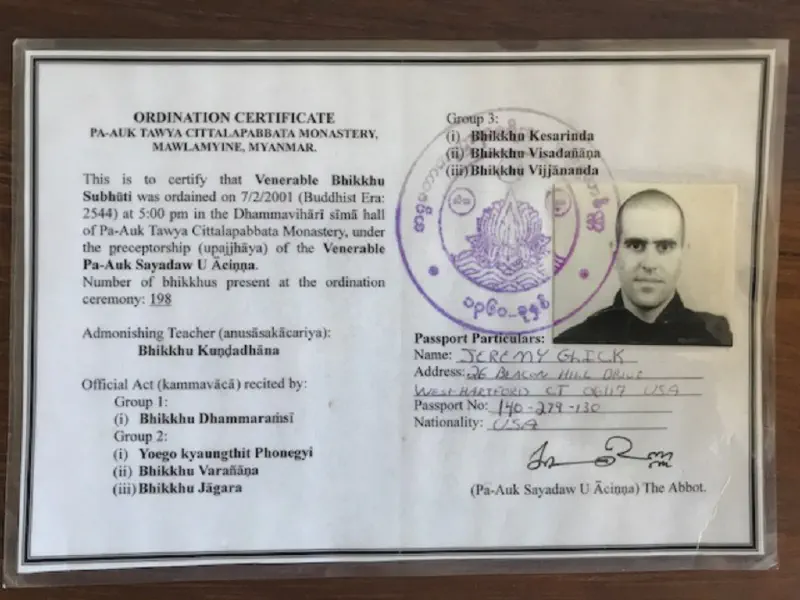
Why I Ordained Twice
Sep 13, 2019
Many people who have learned that I have re-ordained and actually know what that means have asked me why I did it. It is a long story, but I will try to be brief. During my first ordination in 2001, at Pa-Auk Main Branch with Venerable Pa-Auk Sayadaw as my preceptor, I was asked 13 questions. According to tradition, every monk is asked these 13 qualifying questions in the ordination ceremony twice. It is a requirement for the ordination that a monk gets taught about the 13 questions before he is officially asked these questions. Because this requirement needs to be verified, the “practice session” has become embedded into the whole ordination procedure. The first time the set of questions are asked, the sangha or group of monks can witness that the candidate was given a lesson. The second round of questions (only 3 minutes later) is for real and the sangha can officially hear the answers for each qualifying question. The official ordination chant called “kamma vaca” follows immediately. After that, the monk is “ordained” and then taught about the robes, food, lodging and medicine requisites.
read more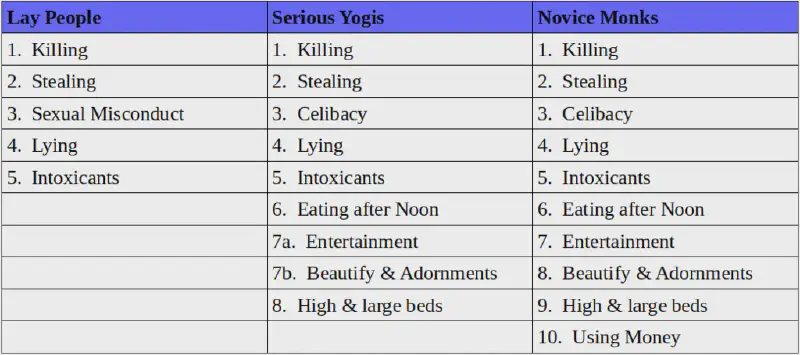
5, 8 and 10 Precepts
Dec 18, 2016
Here is a comparison of 5, 8 and 10 precepts. The Buddhist who follows five precepts is known as a regular lay Buddhist. The person who follows 8 precepts is known as a serious Buddhist yogi. The person who follows the 10 precepts is known as a novice monk. A bhikkhu follows 227 rules.
It is important to know these classes to know which rules are more important to follow. It also can explain, what class of rules a monk is following. It is a unique way of looking at Monastic Morality. It is also important for lay people who take 8 precepts to really take real 8 precepts. If a lay person takes 8 precepts but knows they will not follow them, they are lying and not only breaking one of the first precepts and generating bad kamma, but they are practicing rights and rituals, something that is in the opposite direction as Enlightenment and what The Buddha preached.
read more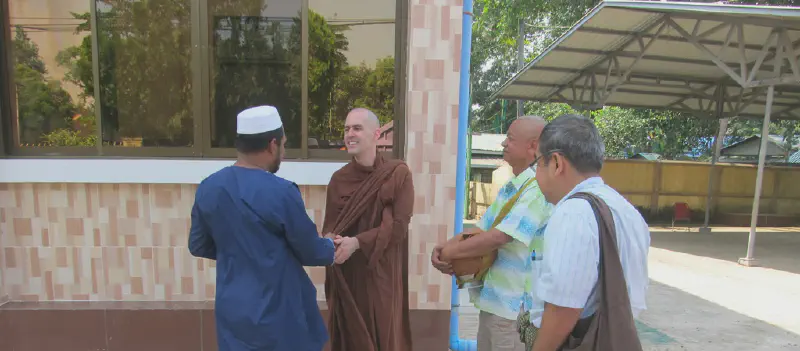
Some Wish For Peace
Nov 17, 2015
Some wish for peace, I did something (story below) I thought I would repost this on my blog due to the recent events. We must strive for peace. Originally posted on WithMetta.net
I just got back from inviting 2 Muslims to serve at the head of the meal line for Tomorrow’s lunch at Pa-Auk. Everyone thought I was crazy and that the Muslims would kill me or at least shout at me as soon as I entered the compound. Instead they sat us down and offered us apples, and fruit juice with a happy and warm welcoming smiles.
read more