Dhamma Talk August 27, 2026 at Katana, Sri Lanka
We are going to talk about two topics today: death and the life continuum, which is known as the bhavaṅga.
The Career That Knows Death
Recently, there have been quite a few deaths nearby among the local village, and the monks are frequently being invited to funerals to give Dhamma talks. There are certain careers where people come to know death much more intimately than the average person. Funeral directors, who run funeral homes and manage the services, know death very well. Doctors, who deal with the sick and dying, also know death well. And, of course, another group that knows death very well is the bhikkhus, because we are constantly invited to these funerals.
There are so many deaths occurring right now that it is hard to keep track. Just a few days ago, someone came to arrange a midnight chanting and Dhamma talk. I was initially confused because the death had occurred a week prior, and I wondered why the body was still at the house. But they explained it was an entirely new death. Like Kisāgotamī, who had to go from house to house looking for mustard seeds from a family completely untouched by death to save her baby, we must realize that everyone deals with death. Once she understood this, her mental disease was cured, and she was able to accept the passing of her baby.
Maraṇānussati App
It is not just our duty to go to funerals that keeps death fresh in our minds. It is also our duty to practice maraṇānussati, the contemplation of death. We shouldn’t only focus on it at funerals; contemplating death is one of our primary duties.
Recently, Venerable MaggaVihāri asked me to add a specific feature to the Buddhist Sun mobile phone application I maintain. He wanted a calculator for modern users to estimate when they will die as a tool for maraṇānussati. The way it works is that you input your birthday and the approximate age you think you will live to—perhaps 80 or 90 years old. It then acts as a countdown timer, continuously ticking away the time you have left. The timer never stops; it constantly reduces your remaining years and days. It is a good reminder, but there was one problem.

Get the Buddhist Sun App (iOS & Android) — Read more & download
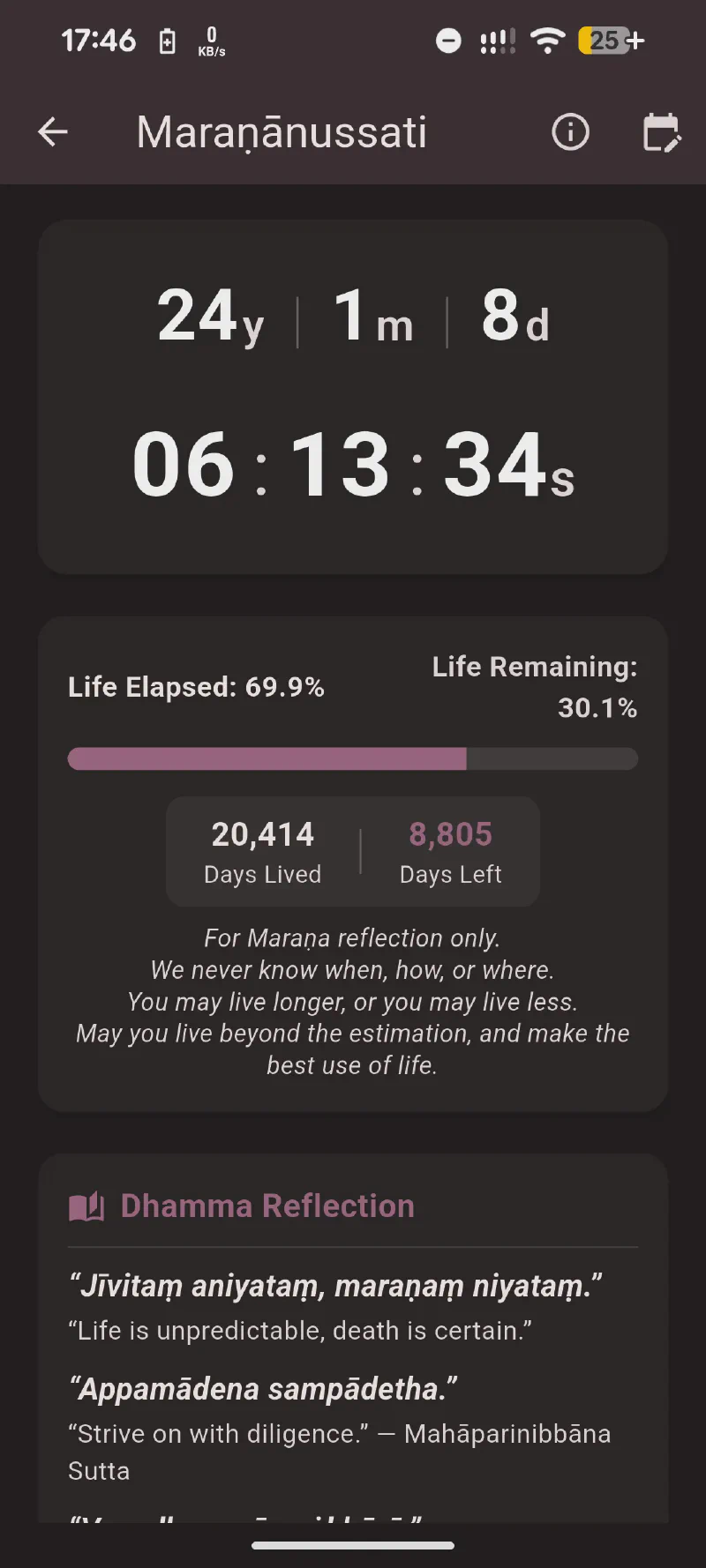
This app is removed. Why? One of my friends, did not like this idea at all. Why? We all know the famous Dhammapada story of the weaver’s daughter. She came late to the Buddha’s teaching due to work. Because she had been focusing on the contemplation of death, the Buddha asked her, “Where did you come from?” and she replied, “I don’t know.” He asked, “Where are you going?” and she said, “I don’t know.” He asked if she knew, and she said yes, but when asked “Do you know?”, she said she didn’t know. The meaning behind this exchange was that she didn’t know where she came from in her past life, nor where she would go after death. While she knew for absolute certainty that she would die, she did not know exactly when or how.
My friend dislikes the countdown timer because, even if it reminds one that one might only have 25 years left to live, it removes the immediate urgency and also gives a fixed time, which cannot exist. It is up to kamma. Sometimes we expect death due to cancer, heart conditions, or old age. But very often, death is entirely unexpected—like in a car accident or a sudden heart attack. It comes suddenly and without warning. My friend feels that if one believes one has 25 years left, one might become complacent and lose the urgency that comes from realizing one could die tomorrow. So, despite it being a good reminder for some, he doesn’t like the timer.
The Unbroken Chain: Linking Life and Death
The main thing I want to teach you today, however, is about the bhavaṅga. We learn about bhavaṅga and its role in the citta vīthi (cognitive series), but it is also very closely related to Paṭicca Samuppāda (Dependent Origination). If you study bhavaṅga, you must also study paṭisandhi (rebirth-linking consciousness) and maraṇāsanna javana (near-death moments). When we think about our bhavaṅga, we are directly thinking about the past-life object taken at our paṭisandhi. It is intimately connected to death. When we study the Abhidhamma, we should constantly reflect on saṃsāra, the dangers of the cycle of rebirth, and the rare opportunity we have today to escape it.
In English, we often translate bhavaṅga as the “life continuum.” Most of you have traveled in a three-wheeler or a car. Vehicles have a mechanical state called an “idle.” The idle provides just enough petrol for the engine to continue running when you are stopped at a sign or a traffic light. If the idle isn’t tuned correctly, the engine stalls and dies. The idle process is essentially the life continuum of the car; it prevents the engine from dying.
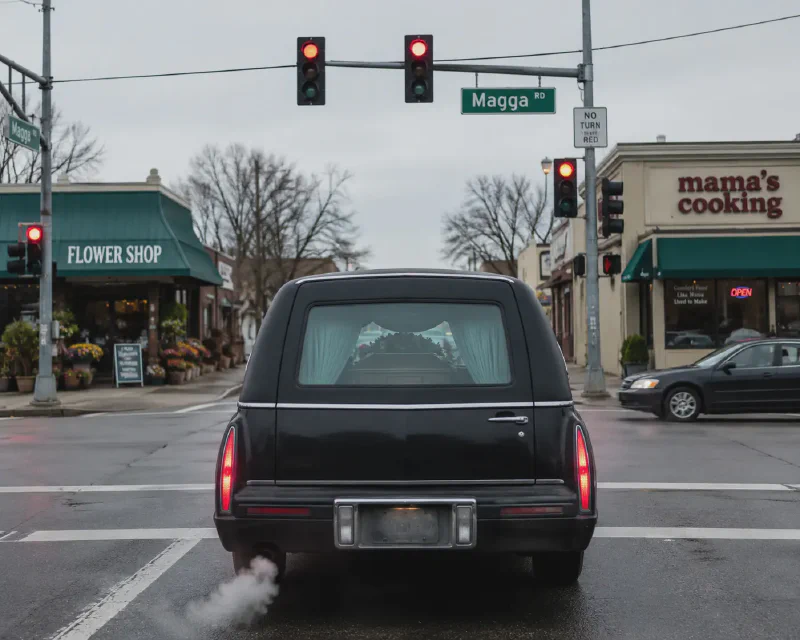
Similarly, there is always a bhavaṅga operating within us, except for those in jhāna concentration or nirodha samāpatti. The bhavaṅga occurs between all sensory processes—between seeing, hearing, smelling, tasting, touching, and thinking. It’s crucial to understand how fast the mind works. Even now, as you listen to me, the vast majority of that time is spent in the bhavaṅga process. You see me, hear my voice, and see my lips moving, and it appears to happen all at once. But as you know from Abhidhamma, these are individual mind moments happening incredibly fast. Because consciousness constantly arises and passes away at different sense doors, but largely resides in the heart base, we often associate the bhavaṅga closely with the heart. We see a little, and then enter bhavaṅga for millions of mind moments. We hear a little, and enter bhavaṅga again. We spend the majority of our time in bhavaṅga.
The Car Idle And The System Idle Process
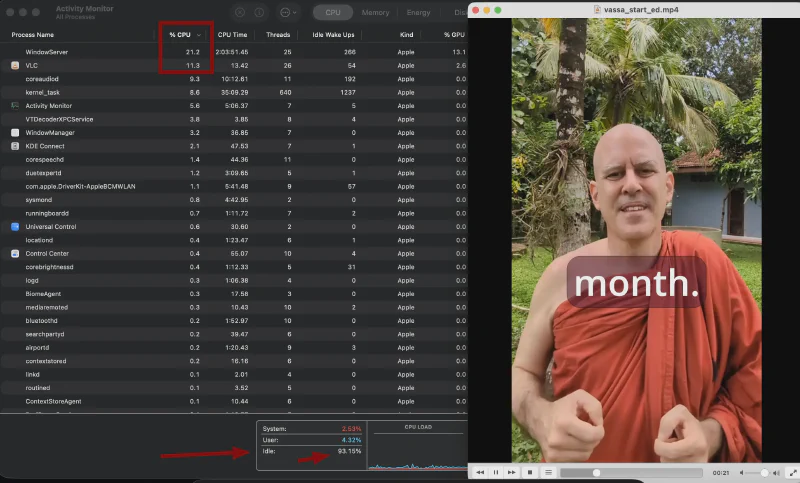
Just as cars have an idle, computers have a “system idle process.” If you check your computer’s task manager while playing a video, you might see that 90% of the processing power is actually taken up by the system idle process. The computer is essentially in its own bhavaṅga 90% of the time. Back when I took a computer science class on operating systems, we learned how single-core processors work. They only do one task at a time. They process one thing, save the state, switch to another task, save that state, and go back and forth so rapidly that it appears multiple things are happening simultaneously. But it is always happening one by one, exactly like our mind moments.
In the 1990s, when you plugged a keyboard or mouse into a COM port, it utilized an IRQ, which represents an interrupt request. Typing on the keyboard or moving the mouse would literally interrupt the computer’s idle state to feed it outside information. This is exactly what happens with our sense doors. The input devices interrupt the computer just as the pañcadvārāvajjana (five-sense-door adverting consciousness) interrupts the bhavaṅga stream to take in data from the outside world.
So, the bhavaṅga stream flows, gets interrupted by sensory processing, and then resumes. We often compare bhavaṅga to a deep sleep or an unconscious state of mind. However, it is a resultant consciousness, and for all of you here, it is a wholesome resultant consciousness. In Abhidhamma, we talk about people being double-rooted (dvihetuka) or triple-rooted (tihetuka)—meaning having non-greed, non-hate, and non-delusion (wisdom). Your root condition is entirely determined by your bhavaṅga. If you are not triple-rooted, you cannot attain jhāna or Nibbāna in this life. But the fact that you are here, interested in and connected to the Dhamma, strongly suggests you are all triple-rooted.
Past Life Connection to Bhavaṅga
In your past life, in order to be born as a human, you had to perform a wholesome kamma. The object of that past wholesome volition is the exact same object taken by your paṭisandhi and your current bhavaṅga. When you make a donation, invite monks, chant at your home altar, and share merit with departed relatives, you are thinking about saṃsāra and cause and effect. By doing these things with wisdom, you cultivate the causes to become triple-rooted.
The specific object in your bhavaṅga could be related to your past generosity. If you offered food, that object might be in your bhavaṅga. If you offered flowers, robes, or scents, that might be the object. You may notice some people have a strong liking for donating specific types of dāna. Doctors love to give medicine; mothers love to offer food. I know a lady who owns a flower shop who constantly offers flowers. Why? I believe it is because of the bhavaṅga. That past object resides deep in their subconscious, constantly present between every moment of seeing and hearing. When people feel a natural affinity for certain good deeds, we might call it their pāramī, but it is highly probable they repeatedly performed these specific actions in past lives.
I once discussed this with another monk, and he argued that because bhavaṅga is just a resultant (vipāka) consciousness from a past life, it doesn’t actively affect your behavior in this life. But if the bhavaṅga didn’t affect you, there would be no difference between being double-rooted and triple-rooted, which determines your ability to attain jhāna or Nibbāna! It absolutely affects your life.
Shaking The Head Influences Our Opinions
Think of a sociology experiment1 where university students listened to music on headphones. One group was instructed to nod their heads up and down to the music. The other group was instructed to shake their heads side to side. Not the Sri Lankan head wiggle. It is side to side, left to right and right to left, like saying, “No.” Afterward, they were asked if they agreed or disagreed with various issues. The group that had been physically nodding up and down was far more likely to agree, while the group shaking their heads side to side was much more likely to disagree. We can apply this to the bhavaṅga. The object of your bhavaṅga is repeating constantly, millions of times a second, like a subliminal message. This continuous repetition, along with your root conditions, profoundly affects your life.
Conclusion
Ultimately, when you contemplate bhavaṅga, you are contemplating saṃsāra. You are reflecting on the dangers of the cycle of rebirth and the necessity of performing wholesome actions to attain Nibbāna. You might wonder, “What is the object of my current bhavaṅga?” But more importantly, you should ask, “What will my future bhavaṅga be? What will my death moment be like? Where will I go next?” We don’t know the exact answers, but we can do the right things now to increase the probability of a good rebirth with the wisdom required to reach Nibbāna.
I hope you can take this reflection and apply it to your life. Use it to cultivate the wisdom to understand Paṭicca Samuppāda. We shouldn’t just mechanically calculate cittas; we must understand how saṃsāra works and how to escape it. All the Dhamma and Abhidhamma we learn ultimately points back to the Four Noble Truths and liberation from suffering.
I wish for all of you to contemplate these teachings deeply so that you may reach Nibbāna safely and quickly. Sādhu, Sādhu, Sādhu. It is my wish that you reach Nibbāna. Now, having spent this time contemplating these deep dhammas, let us share merit and close the session. I am very happy to see your positive engagement while I was speaking. I saw many heads moving up and down just like the experiment.
Note: Please take a look at the generated picture again. You will notice several things. Death, Bhavaṅga, Idle of a car. The Flower Shop, Giving Food represent possible bhavaṅga objects. The name of the road represents the way to Nibbāna.
Summary Poem
Death is certain, yet the hour unknown,
Kisāgotamī, mustard seeds not shown.
No timer counts the moment to part,
Urgency must dwell within the heart.
Like engines idling when the vehicle stops,
Or background processes till the next task drops,
The bhavaṅga flows beneath our waking time,
The senses interrupt like wind and chimes.
From past-life kamma this quiet stream took and flowed,
Three wholesome roots from the seeds sowed.
Reflect on saṃsāra, plant good deeds today,
Until Nibbāna, may we all find the way.
Gary L. Wells & Richard E. Petty (1980), “The Effects of Overt Head Movements on Persuasion: Compatibility and Incompatibility of Responses,” Basic and Applied Social Psychology, 1(3), 219–230. ↩︎
Click below to search subjects
Join Our Mail List
Get updates on new Dhamma teachings, essays, and videos delivered to your inbox.
Subscribe to Updates