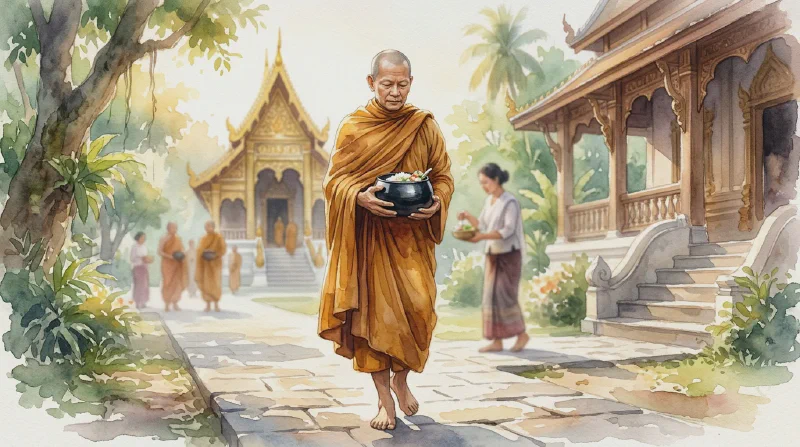
If you look around today, you will notice many Buddhist monks handling money, carrying wallets, or paying for items. This often confuses people.
According to the common Western perception, a Buddhist monk is supposed to be penniless. He should not handle money; he should live simply with his bowl and robes, walking through the village when he needs food. While people often call this “begging,” monks do not actively beg. We walk quietly on almsround (piṇḍapāta), giving people the opportunity to offer food if they wish—a completely passive practice.
That Western perception is 100% correct according to the Vinaya (monastic discipline). Monks are strictly forbidden from using or accepting money.
The Rules on Money
The prohibition against money starts on day one:
The 10 Precepts of a Novice (Sāmaṇera)
The tenth precept is jātarūpa-rajata-paṭiggahaṇā veramaṇī, which translates to abstaining from accepting gold and silver. In the ancient commentaries and the text itself, this explicitly includes all forms of currency, cash, and money.
The Rules for a Fully Ordained Monk (Bhikkhu)
In the Pātimokkha, there is a strict rule (Nissaggiya Pācittiya 18) forbidding a monk from accepting gold, silver, or money, having someone accept it on his behalf, or consenting to money being deposited for him. Doing so requires the monk to forfeit the money and confess the offence.
How Laypeople Can Support a Monk: The Kappiya System
The Vinaya provides an allowable way for supporters to provide for a monk’s needs through a helper, called a kappiya (or kappiyakāraka—one who makes things allowable).
The procedure comes from the Rāja-sikkhāpada (the King’s Messenger rule, NP 10). However, the Vinaya lays down very strict boundaries on how this works:
1. What a Monk Can (and Cannot) Say
If a donor approaches a monk and offers cash:
- The monk cannot say: “Give that money to my kappiya.”
- The monk must say: “Monks are not allowed to accept money.”
If the donor then asks: “Do you have an attendant who looks after you?”, the monk is permitted to point out the helper: “Yes, that person over there assists me.” Even then, the monk cannot order the donor to hand over the cash.
2. The Language of the Offering (Pavāraṇā)
To avoid making the monk a party to financial transactions, the donor places the funds with the kappiya and then gives an invitation (pavāraṇā) to the monk.
- Incorrect way: “I donated $50 of money to your kappiya for you.” (This is ambiguous and implies ownership of money).
- Proper way: “I have deposited allowable requisites having the value of $50 with your attendant. Please ask him whenever you need allowable items (such as medicine, robes, or travel tickets).”
If a donor leaves funds with an attendant but forgets to invite the monk, that arrangement becomes “dead money”—the monk cannot ask for anything from it because he has not received the formal invitation.
What if a Monk Wants and Expects Money?
In reality, the majority of monks today habitually accept and use cash. If you encounter a monk who clearly wants money, should you give it to him anyway?
Consider an analogy: many homeless individuals struggle with alcohol or drug addiction. Even if that is what they want and what they will spend money on, you would not hand them a bottle of liquor or drugs just to “skip a few steps.” Giving cash to a monk who breaks the rule only reinforces unallowable behavior.
Instead, support the monk properly:
- Ask for a kappiya: If you want to help, first ask if he has an attendant handling requisites.
- Act as your own kappiya: If a monk habitually handles cash, he probably does not have a formal kappiya. In that case, you can make a personal invitation directly: “Bhante, if you need any allowable items up to the value of $50, please let me know and I will purchase them for you.”
The Trade-Off of Direct Invitations
This direct approach can be somewhat fragmented. When ten people deposit funds with a single kappiya, that helper can combine the donations to buy high-ticket items the monk might need, such as an airfare or major medical treatment.
A single $50 invitation cannot buy a plane ticket, but it can still cover practical everyday requisites: a hot meal, replacement batteries, or minor repairs. Most importantly, it supports the monk without compromising the Vinaya.
The Reality
When the Vinaya is followed properly, the monk never owns, touches, or manages money. The attendant manages the funds entirely, and the monk only receives the allowable physical items he needs.
If you see a monk walking into a shop to buy his own food, purchasing his own bus tickets with cash, or tapping a debit card, he is acting directly contrary to the Vinaya laid down by the Buddha. The standard of living without money remains just as clear and relevant today as it was 2,500 years ago.
Summary Poem
A bowl, three robes, a quiet pace,
A life of calm, restraint, and grace.
No gold, no coins, no worldly gain,
To keep the holy life unslain.
When faith inspires a gift to share,
A kappiya attends with care.
Allowable things the monk receives,
True to the Dhamma he believes.
Click below to search subjects
